
What Determines Whether Your Tattoo Removal Succeeds
- Oct 26, 2026
 Two people can start tattoo removal on the same day. One is finished in five sessions. The other is still going a year later.
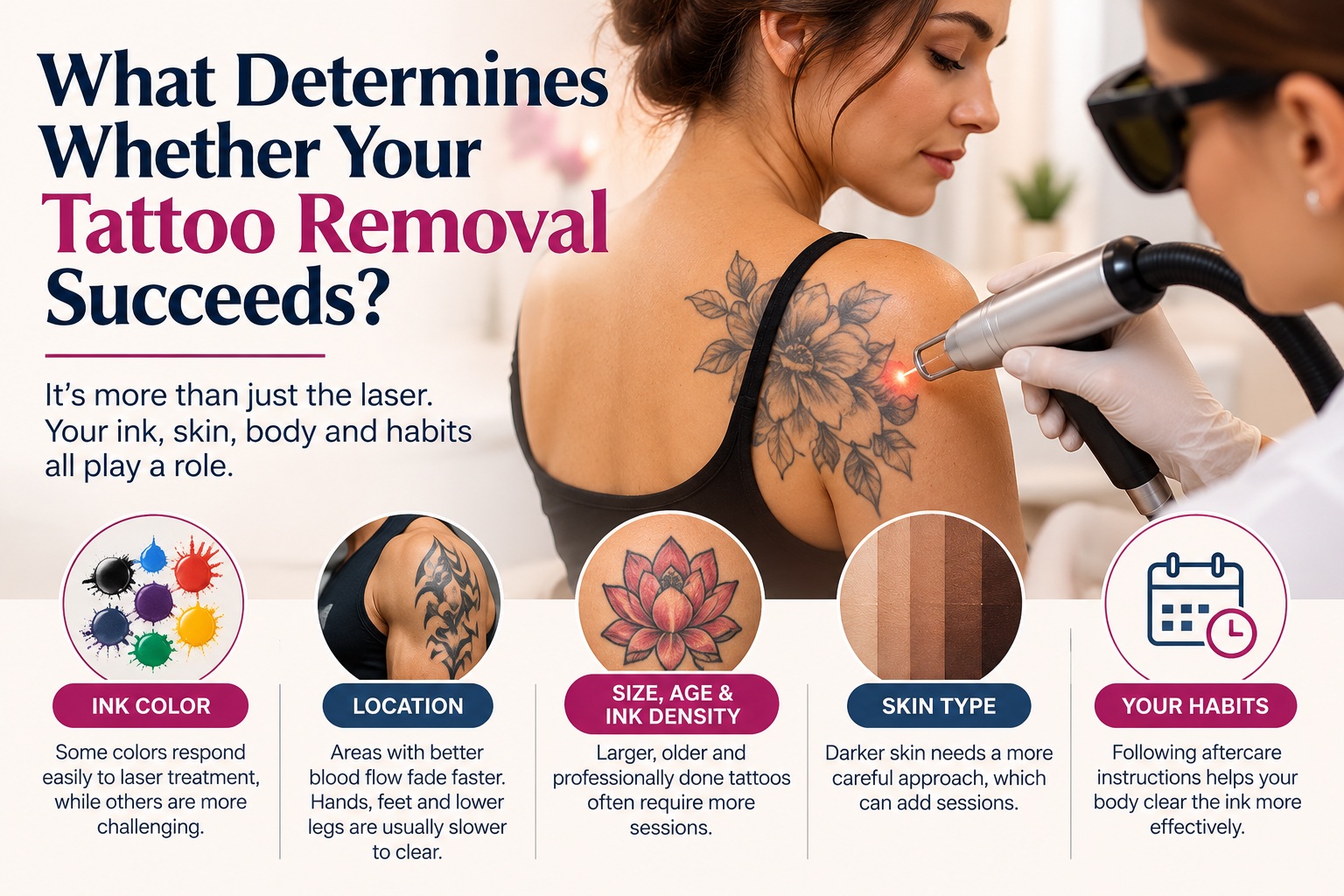
Why the difference? Because tattoo removal is not one-size-fits-all. The laser matters, but so do your ink, your skin, your body, and your habits. Here is what really shapes your results.
Ink Color Makes a Big Difference
Some colors absorb laser energy easily. Others push back. Here is a general guide.
Ink Color | Typical Laser Response | Removal Considerations |
Black and dark blue | Generally respond well | Often easier to remove |
Red and orange | Often respond well to suitable wavelengths | Results depend on the pigment and laser used |
Purple | Variable response | Depends on the pigments used to create the color |
Green and light blue | Can be more challenging | May require specialized wavelengths and additional sessions |
Yellow and white | Often difficult to remove completely | May respond poorly to commonly used tattoo-removal lasers |
Where Your Tattoo Sits on Your Body
Location affects how quickly your body can carry ink away. Areas with strong blood flow tend to fade faster.
- Faster to Fade: Chest, neck, and upper arms
- Slower to Fade: Hands, ankles, feet, and lower legs
Tattoos on the feet and legs are among the toughest to remove.
Also Read: How Does Laser Tattoo Removal Work to Fade Ink?
Size, Age, and How the Tattoo Was Done
- Size: Bigger tattoos hold more ink. Larger tattoos may require more sessions to remove.
- Age: Older tattoos may be harder to clear.
- Ink Density: Professional tattoos pack in more ink than amateur ones, so they often need more sessions.
- Cover-Ups: Layered ink means more pigment for the laser to work through.
Your Skin Type
On lighter skin, the laser can easily tell ink apart from natural pigment. Darker skin needs a more careful, conservative approach to protect it, which can add a few sessions. Clinicians often use tools like the Kirby-Desai scale, which scores skin type, location, color, ink amount, scarring, and layering, to estimate how many visits you will need.
Ready to Take the Next Step?
If there is a tattoo you are ready to say goodbye to, the team at Rani MD would love to help you figure out the best way forward. They will look at your tattoo, your skin, and your goals, and give you an honest idea of what to expect.
Just give us a call at (408) 761-5953 or drop a note to info@ranimd.com to book your consultation.
Frequently Asked Questions
1. Which tattoo ink colours are the hardest to remove with a laser?
Green, light blue, yellow, and white inks can be more challenging to remove, depending on their pigments and the laser wavelengths available. Black and dark blue inks often respond more readily to suitable laser treatments, although individual results vary.
2. Does tattoo location affect how many laser removal sessions are needed?
Yes. Tattoos on areas such as the hands, feet, ankles, and lower legs may fade more slowly than tattoos closer to the torso. Differences in circulation, lymphatic clearance, and other individual factors can influence how quickly the body processes fragmented ink.
3. Are older tattoos easier to remove than newer tattoos?
Older tattoos may have faded naturally over time, which can make some easier to treat. However, age alone does not determine removal success. Ink colour, density, depth, tattoo technique, and skin characteristics also affect the outcome.
4. Why can professional tattoos take longer to remove than amateur tattoos?
Professional tattoos often contain denser, more evenly distributed pigment and may have ink deposited deeper in the skin. Amateur tattoos can sometimes require fewer sessions, but this depends on the amount, type, and depth of the ink.
5. Can darker skin be treated safely with laser tattoo removal?
Yes, laser tattoo removal may be possible for darker skin tones, but treatment requires careful assessment and appropriate laser settings. Certain laser technologies and conservative treatment approaches can help reduce the risk of burns and pigment changes. A qualified clinician should assess individual suitability.
6. What is the Kirby-Desai scale used for in tattoo removal?
The Kirby-Desai scale is a clinical tool used to estimate the likely number of laser tattoo removal sessions. It considers factors such as skin type, tattoo location, ink colour, ink density, scarring, and layering. It provides an estimate rather than a guarantee of the final result.
7. How can a consultation at Rani MD help estimate tattoo removal results?
A consultation allows the clinical team to assess the tattoo's colours, size, location, ink density, and the individual's skin characteristics. These factors help inform a treatment plan, discuss potential risks, and establish realistic expectations for the number of sessions and degree of fading.